LIFE OF A STAR TEXT
Life of Star Text © Steven Faivus, 2024
A. Birth of a Star
A star begins as a large cloud. The cloud is mainly hydrogen dust floating in outer space. Gravity pulls the cloud, called a nebula, towards its center. As the cloud shrinks, its middle gets thick and hot. In the center of the shrinking cloud, the building, thickening heat leads to rising pressure.
Soon the center, too hot and dense, has such high pressure and force that the hydrogen atoms are pushed together. The core starts to explode with nuclear fusion. New atoms are born in this confusion. Intense light streams away through the sun’s crown. A star is born!
B. Stable star
Once gravity has shrunk the cloud enough that it’s middle starts to explode, it becomes a stable star. Heat pushes out. Gravity pulls in. An average-sized star like the Sun holds its size like this for about 5 billion years. During this time, it’s center burns with nuclear fusion explosions. Two hydrogen atoms stick together to form one helium atom. When this happens, a little mass is lost and changed into a very large energy.
When a star begins to burn, the explosions strip its gas of their electrons, and the gas becomes charged plasma. During its life, a star’s plasma churns, or turns over and over again. The heated plasma rises up from the exploding center. At the surface, the plasma releases light and cools. The plasma, now cooler and heavier, sinks back down to the center, where it heats and rises again.
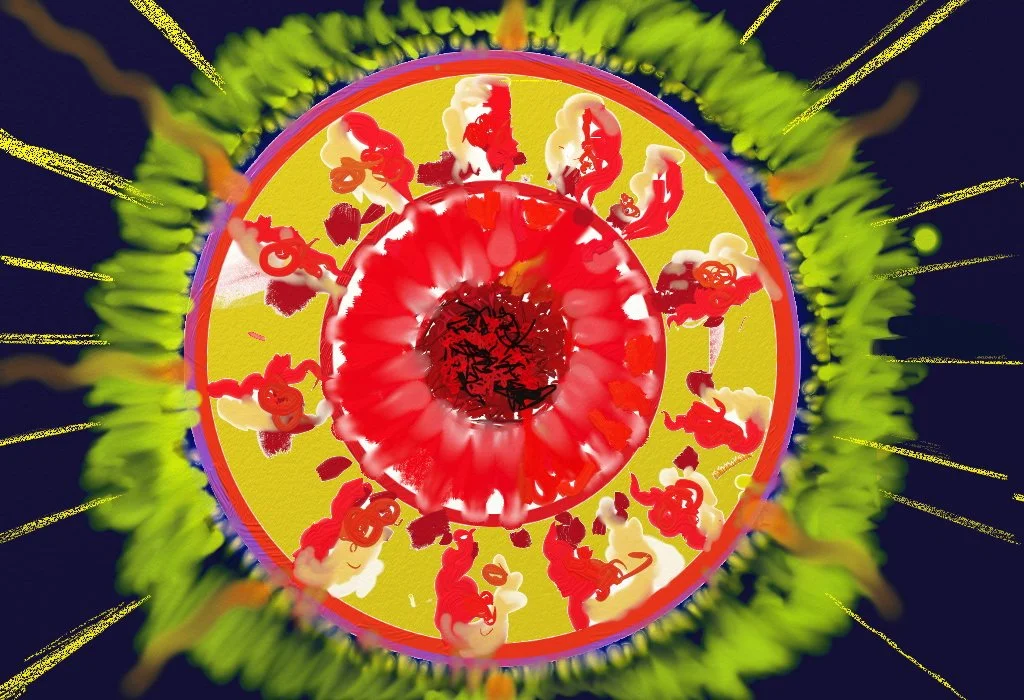
A stable star has five layers. After the exploding Core, heated plasma rises up through the Radiation Zone. After the Radiation Zone comes the Convection Zone. Here's hot plasma rises, reaches the surface, cools, and sinks back down. At the surface, the hot plasma gives off light, which streams out into space in every direction. This area, surrounding the star’s surface, is called the corona, or crown.
C. The death of a star
When the hydrogen for the exploding center is used up, the star’s core finally stops burning. Now gravity, unchecked by expanding heat, takes over and collapses the star. What happens next depends on the size of the star.
When a large star’s dying body collapses into a tight space, heavier atoms – like plutonium and uranium – explode in a huge nuclear explosion called a supernova. In a supernova, heavier atoms are created and sent flying out into space in all directions.
What happens to a star after it dies, how brightly a star burns, and how long a star lives depends the size of the star. Larger stars burn brighter, live shorter lives, and have more explosive deaths. The largest kind of stars collapse into impossibly small spaces and become the super dense black holes.
Our sun, a typical-size star, is about half way through its 10 billion year life. In another 5 billion years (that's 9 zeros) our sun will run out of its hydrogen fuel. It will collapse then briefly expand into a red giant.
From Wikipedia:
“Our sun is too small to explode. It would need to be 1.4 times as massive to nova, and 9 times more massive (or more) to supernova.
It will, however, gradually begin to expand into a red giant, some four billion years from now. It will burn only fairly briefly as a red giant, swallowing Mercury and Venus, and possibly even engulfing the earth. It will burn that way for a fairly brief period, just a few million years, before collapsing to a white dwarf. It will burn hot and bright as a tiny white dwarf for several billion years more, before gradually burning out altogether--a fading ember in the heavens.
Read more: http://wiki.answers.com/Q/When_will_our_sun_explode_and_turn_into_a_white_dwarf#ixzz1ubP6MTmf
Suggested Links To Get Started:
1. Start with Drawing States of Matter here.
2. Sing along with Matter music videos here.
Check out the matter videos by teacher and rappers from our school community.
RESOURCES