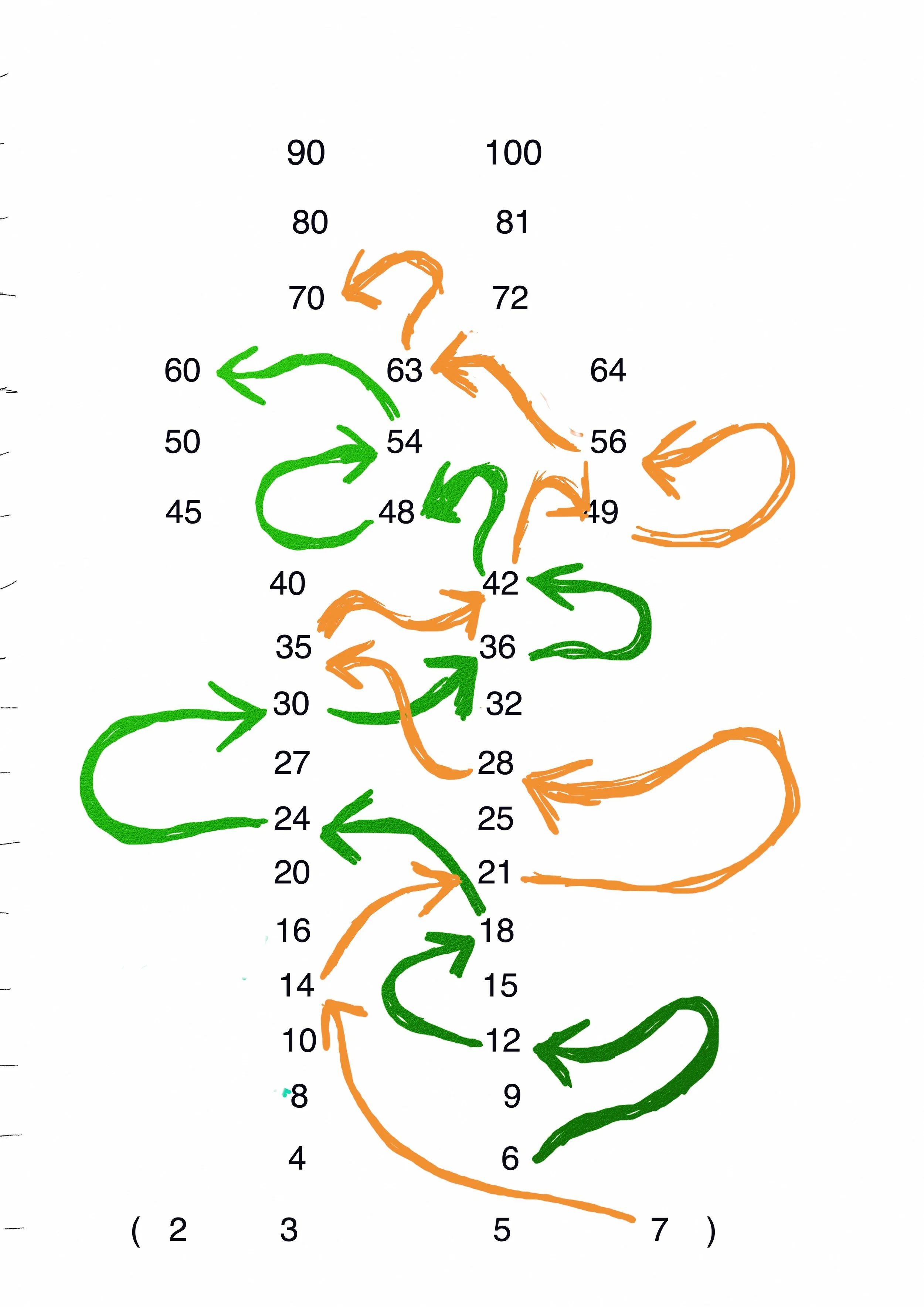
MULTIPLICATION in NGSS and MATH COMMON CORE STANDARDS
Multiplication shows up very differently in the Next Generation Science Standards (NGSS) compared to K-12 Mathematics Standards (such as the Common Core). While math standards treat multiplication as a core arithmetic operation and structural tool, the NGSS treats multiplication implicitly as a conceptual mechanism for quantifying nature, scaling systems, and analyzing proportional relationships.
1. How Multiplication Appears in Math Standards
In mathematics, multiplication is formally introduced, developed, and expanded across elementary and middle school as a primary operational domain:
Foundations & Conceptual Introduction (Grades 2–3):
Students are introduced to multiplication via equal groups, arrays, and repeated addition.
By Grade 3, students build fluency with multiplication facts within 100 and understand properties of operations (commutative, associative, and distributive properties).
Multi-Digit Operations & Multiplicative Comparisons (Grade 4):
Multiplication shifts from simple grouping to multiplicative comparison (e.g., interpreting $35 = 5 \times 7$ as "35 is 5 times as many as 7").
Students master multi-digit multiplication algorithms using place value.
Fractions, Decimals, and Proportions (Grades 5–7):
Multiplication expands to rational numbers, fractions, and decimals, eventually laying the groundwork for ratios and proportional relationships in Grade 7 (scaling quantities up or down).
2. How Multiplication Appears in the NGSS
The NGSS does not feature explicit math formulas or computational algorithms (you won’t find a standard requiring students to multiply $45 \times 12$). Instead, multiplication is embedded within the Science and Engineering Practices (SEPs) and Crosscutting Concepts (CCCs)—specifically under Scale, Proportion, and Quantity and Systems and System Models.
Scale, Proportion, and Quantity:
Science requires students to recognize that phenomena happen at very different scales—from subatomic particles and cellular structures to tectonic plates and astronomical distances.
Students use multiplication when scaling quantities up or down. For example, calculating total mass, energy transfer, or population density often requires multiplicative scaling (e.g., if one organism consumes a certain amount of energy, multiplying that across a trophic level or food web).
Mathematical and Computational Thinking (SEP):
The NGSS explicitly demands that students "use mathematical representations of phenomena."
Multiplication is used to model relationships in science, such as calculating density ($Mass = Volume \times Density$), determining speed or force, or scaling map ratios and ecosystem models.
Proportional Reasoning in Earth and Physical Sciences:
Upper elementary and middle school science tasks require students to interpret models where variables scale proportionally, relying on the exact multi-step problem-solving and proportional logic taught in parallel math classes.
Summary Comparison
Dimension
In Math Standards (e.g., Common Core)
In Science Standards (NGSS)
Primary Focus
The operation itself—fluency, algorithms, properties, and number systems.
The application—using multiplication as a tool to measure, scale, and describe physical phenomena.
Key Contexts
Arrays, area, equal groups, fractions, and algebraic equations.
Proportions, data modeling, population scaling, and rates of change.
Progression
Explicitly graded (introduced in Gr. 2/3, mastered in Gr. 4/5, applied in ratios in Gr. 6/7).
Integrated fluidly whenever students need to handle magnitudes, quantities, or proportional relationships.