
ATOMIC BONDS in NGSS Standards
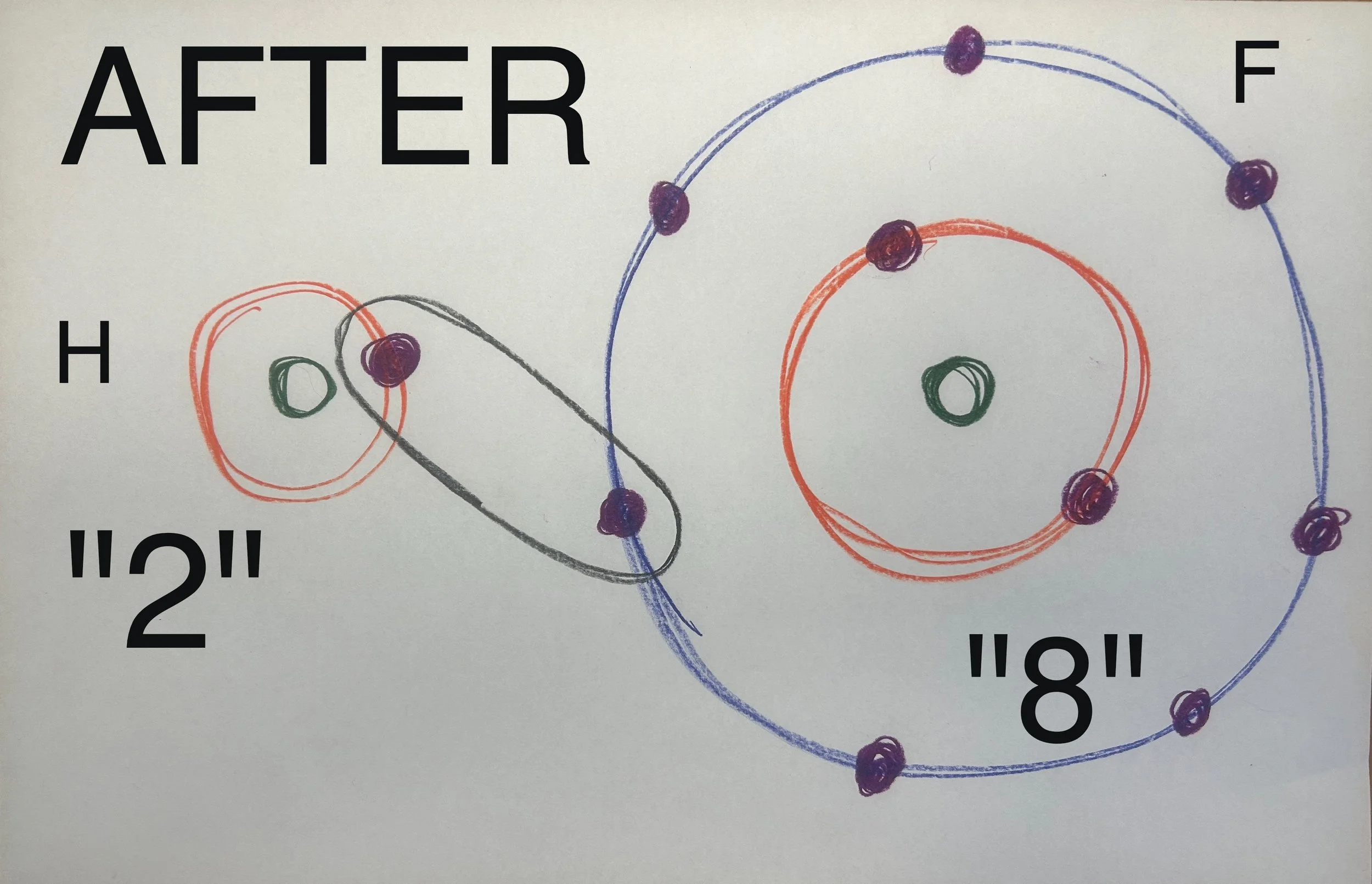
In the Next Generation Science Standards (NGSS), atomic bonds progress from a purely qualitative understanding of "sticky particles" in elementary school to complex microscopic models and electrostatic descriptions in middle and high school.
Rather than memorizing names of bonds, students focus on the Disciplinary Core Idea (DCI) PS1.A: Structure and Properties of Matter and PS1.B: Chemical Reactions. This progression traces how atomic rearrangements and electron states dictate macro-scale properties and overall energy transfers.
1. Elementary School (Grades 2–5): Mixing and New Substances
At this stage, the word "bond" is not explicitly introduced, but the foundation for chemical changes is laid down.
5-PS1-4 (Chemical Reactions): Conduct an investigation to determine whether mixing two or more substances results in new substances.
Focus: Observational evidence of chemical reactions (e.g., color change, gas production) where particles change their configurations.
2. Middle School (Grades 6–8): Molecular Models and Atomic Regrouping
Middle school explicitly targets how atoms combine to form molecules, focusing heavily on utilizing structural models.
MS-PS1-1 (Structure and Properties of Matter): Develop models to describe the atomic composition of simple molecules and extended structures.
Bonding Concept: Students learn that pure substances are made from single types of atoms or atoms bonded together in specific molecular patterns (like \(H_{2}O\) or \(CO_{2}\)) or giant crystalline arrays (like \(NaCl\)).
MS-PS1-5 (Chemical Reactions): Develop and use a model to describe how the total number of atoms does not change in a chemical reaction and thus mass is conserved.
Bonding Concept: Chemical reactions are framed as a process where bonds break and new bonds form as atoms regroup into entirely new molecular configurations.
3. High School (Grades 9–12): Valence Electrons, Electrostatics, and Energy
In high school, bonding is fully explored through subatomic behavior, electrical forces, and thermodynamics.
HS-PS1-1 (The Periodic Table & Outermost Electrons): Use the periodic table as a model to predict the relative properties of elements based on the patterns of electrons in the outermost energy level of atoms.
Bonding Concept: The standard explicitly states that students must use valence electron states and electronegativity patterns to predict the number and types of bonds (ionic, covalent, or metallic) an element will form.
HS-PS1-3 (Bulk Scale vs. Electrical Forces): Plan and conduct an investigation to gather evidence to compare the structure of substances at the bulk scale to infer the strength of electrical forces between particles.
Bonding Concept: Students connect bond types and intermolecular forces to physical traits like melting point, boiling point, and surface tension.
HS-PS1-4 (Total Bond Energy): Develop a model to illustrate that the release or absorption of energy from a chemical reaction system depends upon the changes in total bond energy.
Bonding Concept: Explores the mechanism that breaking bonds requires input energy, while forming new bonds releases energy. The net difference determines if a reaction is exothermic or endothermic.
Summary Table: Bonding Progression by Grade Band
Grade BandMicroscopic FocusCore NGSS Performance ExpectationElementary (K-5)Particles mix together to form new substances with different properties.5-PS1-4Middle School (6-8)Atoms regroup and rearrange into new molecular structures.MS-PS1-1, MS-PS1-5High School (9-12)Valence electrons drive ionic/covalent choices; bond energy dynamics dictate energy transfers.HS-PS1-1, HS-PS1-3, HS-PS1-4